Me? I’m a Human in Progress!

HumanInProgressPic

If you know me, you know that I like to call myself a work in progress. I firmly believe that all of us as human beings should always be works in progress. We should constantly be learning, striving, improving.

For me, that has been particularly true in the last year. New city – from Dallas to Hurst. New home – from a townhouse to a ranch-style house. New job, even – from non-profit to the corporate world.

And new diet. Dramatic new diet. No, I’m not talking about Keto or Paleo or Adkins or Weight Watchers (sorry, I think it’s rebranded as WW Inc. now). I’ve never been a fan of “diets,” per say. More power to those that live by them, especially those that move from one new diet to the other. Whatever works for you, right?

I’m all about lifestyle changes. Try something that you think you can live with and tweak along the way as necessary until you have it just right and then you keep on keeping on. So I turned vegetarian in February. That wasn’t my first time trying out the all-veggies world. I did it for 15 months about four years ago. Obviously, it didn’t stick.

But several things were brewing in the last couple of years. My disdain for beef grew exponentially until it became a site difficult for me to bear. Also, my ease of slipping into a day or days of no meat, chicken or fish became pretty much an afterthought. So the move to being a vegetarian once again seemed a no-brainer.

Then I started tweaking. I slowly started deleting dairy, little by little, and then it was poof…gone. We recently had our biometrics screening tests at work. We have those every year. I wasn’t happy with my blood glucose number. Not happy at all. So I began vegetarian low carb almost a month ago.

That’s right – bread, pasta, rice, pastries, desserts, chips, cereal…gone, gone, gone, gone, gone. I still eat granola in the mornings. I buy the Bear brand vanilla almond granola, which is only 4 grams of sugar per serving. I still drink my sweetened coconut milk, which is about 7 grams of sugar per serving. I still put honey in my hot tea. I eat quinoa. I eat dark chocolate, which as long as you stick with at least 80% cacao is pretty low in sugar. I eat peanut butter, which is also lightly sweetened.

I’m learning all about low glycemic index foods, and how some fruits are really good for blood glucose control. It’s the same thing with vegetables, because some are better than others when it comes to natural sugar and carbohydrates.

By the way, I do eat eggs. That is the only animal product I eat. I enjoy eggs, they are good for you, and you don’t need to kill an animal to eat an egg. I eat two eggs a day. They are a great source of protein, filled with lots of nutrients. I stick to my two eggs a day rule, which is still very much in the healthy range. Yes, I’ve read up on it.

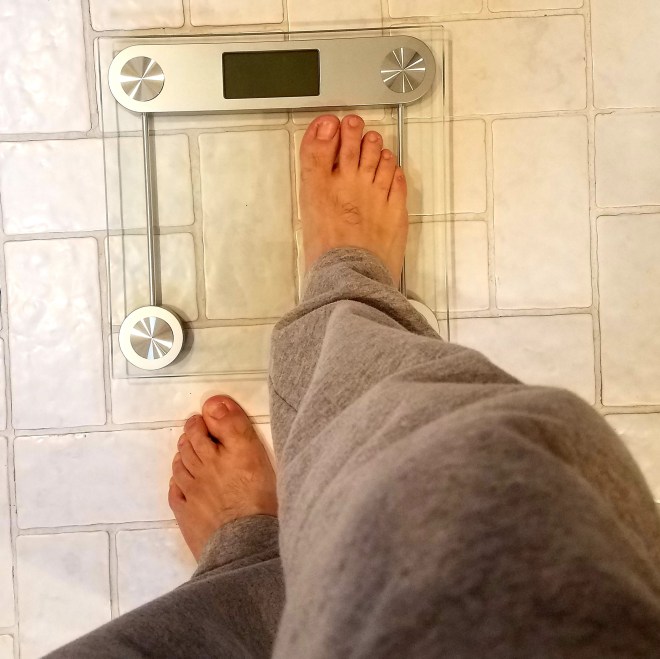
So what has happened in the last couple of weeks? Let me tell you! I weighed myself this morning before breakfast and the scale read 164.4 pounds. The last time I even came close to that weight was 167 pounds in 2004 right after lower back surgery. I’m thrilled! My clothes fit nice and loose. I feel better. Walking 16,000 steps a day and doing Pilates once a week make me feel so light on my feet, my body.

There is also a psychological benefit here. I was not blessed with the world’s greatest genes – diabetes, high blood pressure, heart disease and cancer all run in my family. I’m also total Type A personality. I hate taking pills other than nutritional supplements. Hate it! I’m a firm believer in treat your body well, give it good stuff, and it will reward you. You build up credit with regular nutritional deposits. Your body responds in kind.

My goal? I want to get to 160 pounds and maintain, maintain, maintain. I’m retesting my blood glucose levels in 6 months. I’m already super positive and much more confident. And you know what? I don’t miss bread, rice, cookies, cupcakes, pasta, pizza, blah…blah…blah. There are better alternatives. There are usually, maybe even always, better alternatives.

I’m a work in progress. No wait, let me tweak that, too. I’m a human in progress. Oh yes, and proud of it.

My Lifelong Love Affair With ’80s Music

80salbums

I turned 15 in the summer of 1980. You know that age – puberty kicked in a couple years before, high school had begun, clothing all of a sudden seemed important, and music became more than just occasional background noise.

That is also the age when lifelong musical tastes are formed. According to research conducted by The New York Times, citing an experiment using Spotify, lifelong musical tastes for men form during ages 13-16. For women, it’s a bit earlier from about 11-14. So yeah, by 15 I was solid on my love affair with ‘80s music.

Now don’t get me wrong, I love ‘70s music. Especially late ‘70s music when disco was in full swing and the Bee Gees, Donna Summer, KC & the Sunshine Band, Village People, Sylvester, and Barry White had emerged as trailblazers and superstars of the genre. To this day mirror balls entice me to don bellbottoms and platform shoes, then go twirl around the dance floor.

But baby, it’s all about the ‘80s. The ‘80s catered to all of my individualistic, artistic and sensationalistic sensibilities. The bright colors, the geometric designs, the savoir faire, and the let-me-express-myself sense of life…I was all about it. ‘80s music took all of that, every single aspect, and set it to notes, lyrics, melodies, rhythms and beats. There is no other decade like it for music, and there never will be.

It is telling that nearly 30 years after that decade ended, the music lives on. You have radio stations dedicated to the era. You have current artists aping the sound, particularly the synthesizers. You have young adults who weren’t even thoughts in their parents’ minds discovering the greatness of the ‘80s discography. And, perhaps most importantly, you have those that lived it still genuinely reveling in its sonic brilliance. This isn’t a guilty pleasure nostalgia trip. This is a signpost of their lives that still remains important.

It is certainly a signpost of mine. As I was preparing to write this blog post, I decided to offer a list of my most important ‘80s artists. I’m talking about artists (bands and solo singers) that emerged in the Me Decade and launched their careers with or without the assistance of the groundbreaking MTV. You know, back during the time when it actually played music videos.

So without further hesitation, and in no particular order, here’s my dozen ‘80s musical mainstays:

Duran Duran – The British poster boys of the New Romantic movement crafted full-package synth-pop. Along with the soaring vocals, indelible melodies and catchy choruses came a stylish, camera-ready fashion sense. Favorite album: 1982’s masterpiece Rio.

SOS Band – Atlanta’s synth-soul ensemble emerged fully formed in 1980 with the crossover hit, “Take Your Time (Do It Right).” I have been a disciple ever since, even through the band’s rocky early ‘90s releases. Their Jimmy Jam & Terry Lewis-produced period still slays me. Favorite album: 1986’s gorgeous Sands of Time.

Culture Club – Boy George can sing the phone book and give it so much personality. Talk about individualism, here was a London band fronted by a drag queen mixing reggae, R&B, rock and disco into its smooth new wave pop. Favorite album: 1983’s not-a-dud-in-the-bunch Colour by Numbers.

Change – Italy and America met halfway during the club-ready run of this studio-polished post-disco group with a slate of revolving singers and a super delicious sound that swept you away. It never fails, if I play a Change CD in the car I’m dancing as I drive. Favorite album: 1980’s amazing debut The Glow of Love.

Tears for Fears – Roland Orzabal and Curt Smith offered dramatic, sometimes cerebral, and utterly sweeping British pop. Their sound was full-bodied and stunningly produced. I can’t relive the ‘80s without Tears for Fears in the picture. Favorite album: 1985’s fabulously undeniable Songs From the Big Chair.

Eurythmics – The beguiling Annie Lennox and the enigmatic Dave Stewart began in The Tourists before morphing into Eurythmics and making stateside history with “Sweet Dreams (Are Made of This).” Annie was all drama and mystery while Dave was stoic passion. Love them! Favorite album: 1983’s arresting stunner Touch.

ABC – Martin Fry and his interchanging cast of band mates took disco, soul and British pop to the theater. Yet the theatricality of ABC was more in its sound than its look, even though the suave Fry rocked satin suits. Songs were mini movies capped by Fry’s robust vocals. Favorite album: 1982’s masterful The Lexicon of Love.

Kylie Minogue – I will admit that Aussie Kylie’s 1988 debut didn’t wow me back then, even though now I consider it a frolicking beginning to an auspicious career. But by the early ‘90s I was sold on her coquettish, drama-infused, fantasy land brand of British dance music. She gets better with age. Favorite album: 2010’s billowing, beautiful Aphrodite.

A-ha – Oh how I love my A-ha! Yes, yes, everybody knows the huge ‘80s hit “Take on Me,” but A-ha made and continues to make so much more. Norway’s trio creates wall-of-sound pop framed by soaring vocals and dashes of dramatic artiness. I still cherish this band. Favorite album: 2000’s hypnotic opus Minor Earth Major Sky.

Depeche Mode – Depeche Mode today is a whole lot different from Depeche Mode in 1981. Back then they were bouncy and catchy with a youthful penchant for grand messages. But the magic remains for the British band that created a legacy of beautifully dark synthesized pop-rock. Favorite album: The landmark perfection of 1990’s Violator.

Pet Shop Boys – London’s Neil Tennant and Chris Lowe will probably never surpass the success of the insanely creative and radio hooky “West End Girls” from 1986. But that’s fine, because their brand of smart, engulfing dance-pop music aged like fine wine. Favorite album: 1993’s deeply resonant Very.

Luther Vandross – Ah, the exquisite Luther. While he is sadly no longer with us, his silky amalgamation of R&B, pop, disco and ‘60s adult contemporary lives and breathes. Few males vocalists, any genre, can match his effortless pipes. The man could sing anything. He was that good. Favorite album: 1981’s star-making solo debut Never Too Much.

And there you have it, my ‘80s dirty dozen. They shaped my musical tastes, honed my musical experience, and gave me unending pleasure. These artists don’t merely take me to another time and place, they frame my creative aesthetic. I am a product of ‘80s music, and I wouldn’t have it any other way.

A Lackluster Paperweight: Memories of My Father


paperweightThe paperweight is now lackluster. The once glistening marble has lost its shine. It even has a corner chip or two. Plus, there’s this permanent film of dust on the plate that doesn’t seem to come off with repeated wiping.
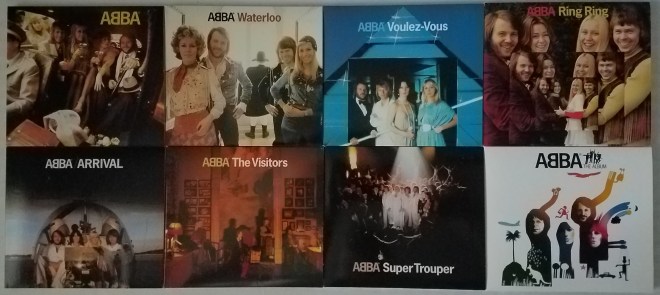
Yet call it a family heirloom, a treasured keepsake, even. This paperweight now sits symbolically on my desk. Every day I look at it and smile as the memories flood back with the warmth of a sun-kissed garden pond. I constantly remember its story, and consequently its emotional significance.

In 1998 I was 10 years into my professional writing career. I had moved to Dallas from Miami four years earlier to become a Staff Critic at The Dallas Morning News. I was covering music, concentrating on the country and Latin genres. A former editor nominated me for one of those Outstanding Young Men of America awards. You know, you get a nomination letter in the mail, you fill out a long questionnaire and some committee decides whether you get in or not. Most everybody gets in, judging by the super thick book they publish. You can buy the book, a plaque, a framed certificate, and a paperweight.

So, when my dad got wind of this he wanted to order that paperweight for his desk. I tried to tell him that this really wasn’t a big deal, that everybody gets in, that I’m only filling this out so that I have something award-like to put on my resume. Nope, he wasn’t budging. He wanted a paperweight.

My dad instilled in me the value of hard work. He was all about finishing what you started. He didn’t care the career you chose, so long as it was legitimate, of course. His main thing was he wanted me to keep at it, excel, be fulfilled, and be happy. I earned an Associate in Arts in Journalism and a Bachelor of Arts in Communication Arts largely driven by my passion for writing and my dad’s prophetic words.

I always felt that he was proud of me, not only because he told me so but also because he always seemed genuinely interested in my career path.

When the paperweight arrived, my dad put it on his desk. As an accountant and bookkeeper who had been self-employed a large part of his professional life, my dad had an office at home. Clients came and went a-plenty, and his tall, gray filing cabinets were overflowing with ledgers, check stubs, and financial statements. His desk was large, rectangular, and it probably weighed a ton. But there sat the paperweight.

Every time I went back to Miami to visit my parents, and whenever I would walk into his office to say hello or goodbye, I would glance and catch sight of the paperweight. But as the years went by I completely forgot about the paperweight. Those last few years of dad’s life I never even noticed if it was still there.

My dad died in late 2012, just 20 days shy of his 84th birthday. I spent the week of his funeral in Miami with mom, my sister and my brother. During a later return to Miami to visit, my brother and I took it upon ourselves to start the cleanup of my dad’s office.

It felt strange to step inside. It was a bit stuffy, a huge change from the AC-fortified ice box my dad liked to work in and was naturally quite cluttered with paperwork. I sat at his desk to begin the organization process.

There it was. On a corner of the desk sat the paperweight. A rush of emotions immediately overtook me. I said to my brother, “Oh my God, he kept it all these years.” He replied, “Of course, Mario, he was very proud of you.”

That was it. There was no containing the tears. I picked up the paperweight, wiped off some of the dust, and said in no uncertain terms, “This is now mine. Forever.”

Two decades after dad bought that paperweight, and about six years after I took it home, it sits on my desk. It’s my marble and metal memory, my keepsake. Yes, my name is on it. But when I look at it, it’s my dad I see. That lackluster paperweight reminds me of him, always. To me, it’s worth its weight in gold.

How I Wrote My Reinvention

Reinvent2
I didn’t set out to be a writer. In fact, when I was in high school I wanted to be a psychologist. When it came time to choose the class ring, I picked the medical symbol to exemplify my career choice.

But as far back as I can remember, way back to my adolescent years, writing always came easy for me. Penmanship was a cinch. Punctuation was second nature. Putting together sentences rarely stumped me. I did well in spelling tests and in essay questions. I was an Honors English student. No sweat.

Yet I never thought twice about it. I wanted to be a psychologist! I wanted to counsel people, listen to their problems, and delve into their past to find the root of the emotional turmoil.

My college years encompassed community college and university. I entered community college as a psychology major and began taking my core courses. One of those core courses was a composition class. The professor had us write compositions and read them aloud. In that class was the new editor of the campus newspaper. One day as we piled out of class, she looked me straight in the eye and asked if I wanted to write for the newly revamped campus newspaper. I thought she was joking.

She was serious. As it turns out, so was I. In a matter of mere weeks I had changed my major from psychology to journalism. That was my first life-altering brush with the wonders of personal and professional reinvention. I stepped out of my comfort zone (psychology) and ventured into something (writing) that until then felt like a hobby.

I spent 25 years writing for major metropolitan newspapers – half-a-dozen as a staff writer for The Miami Herald and a whopping 19 years as a music critic for The Dallas Morning News.

When I left The Dallas Morning News in 2013, I was completely burned out from the world of critiquing late-night concerts, reporting music industry news and trends, and writing comprehensive, authoritative, career-spanning obituaries of influential musicians on a crunch deadline of 90 minutes. I couldn’t do it anymore.

It was time for another reinvention. I had my second career in public relations all mapped out. Well, at least in my head. Yet being away from the competitive, downright cutthroat arena of job hunting for two decades was an uphill climb.

As I searched, I freelanced. I wrote press releases for local theaters. I wrote website biographies for local and national musicians. I wrote blog reports for an accounting firm. That was an experience! I took two contract positions – first as the PR coordinator for a homegrown fiddle festival, and then as an apprentice publicist for a boutique agency that catered to the hospitality industry. I was so detoured from my comfort zone that I lost the map.

Yet my reinvention was far from complete. I spent a year and a half as the Public Relations and Marketing Manager for a Dallas-based education non-profit organization, learning not only the inside of the educational system but most importantly how crucial it is for children from low-income families and poverty-stricken neighborhoods to have access to nurturing, arts- and science-focused after-school programs. I told stories, documenting in blogs, newsletters and press releases the evolution of impressionable kids.

And now, 35 years after that fateful college composition class I’m part of the marketing team at a financial services company for the trucking industry. I work in Fort Worth and live in Hurst. My Dallas days are long gone.

Reinvention introduced me to another world that I only knew in passing. As a Bilingual Communications Specialist I write blog stories, press releases, brochures, newsletters, and email blasts. I translate website copy from English to Spanish, as well as daily mailers, flyers, and applications. I tell client success stories, narrate how-to videos, and arrange media interviews.

I love it. The only constant in life truly is change. Stepping out of our comfort zones is how we grow as human beings. The art of reinvention makes us strong, capable. How we acclimate to the newness, how we find our way in uncharted territory is exactly how we test our mettle. That’s the psychologist in me talking, and the writer in me communicating.

Mamma Mia! Let’s Celebrate the Magic of ABBA!

ABBApic

The scene: A picturesque Greek island, a turquoise evening sky, and Cher. Across a sparkling villa she spots a man that once stole her heart, prompting a rush of sweet memories. The music begins and she sings: “Can you hear the drums Fernando.”

That’s the most memorable moment from Mamma Mia! Here We Go Again, the sequel to 2008’s Mamma Mia!, the film version of the stage musical celebrating all things ABBA.

Cher, naturally, steals the movie with that one performance. Think about that for a minute. Superstar Cher, one of the most iconic, distinctive voices in popular music, is singing ABBA. For those following the amazing, downright magical endurance of ABBA’s music, this is clearly the shimmering feather in an already sequined cap.

The stats speak for themselves. Since the 1992 release of Gold: Greatest Hits, the 19-track compilation CD gathering most of ABBA’s memorable radio anthems, the band’s resurgence has been steady, healthy, and quite lucrative. What’s most remarkable is Gold not only came out more than a decade after ABBA called it quits, but it didn’t usher in a reunion tour, or a new album, or a tell-all book. Nothing. And yet, Gold has sold 6 million copies in the United States alone.

But there’s more. Mamma Mia!, which made its stage debut in 1999 in London, enjoyed a 14-year run on New York’s famed Broadway with 5,758 performances. The Mamma Mia! film grossed $144 million at the US box office. Mamma Mia! Here We Go Again, released barely a month ago, has so far taken in $91.8 million in the United States.

Numbers don’t lie. The music of Anni-Frid Lyngstad, Björn Ulvaeus, Benny Andersson and Agnetha Fältskog continues to enthrall the generation that first experienced it as well as generations since.

Benny and Björn, the songwriting masterminds behind the ABBA canon, created pop music masterpieces. They took layered melodies, quirky yet clever lyrics, and then dressed them up in an engulfing wall of sound. In the space of four minutes, beautifully adorned by the harmonious vocals of Agnetha and Frida, an ABBA song became your transportation capsule to another realm. You were swept away…willingly.

My life partner Steve, who like me experienced the ABBA ascension as it was originally happening, still listens to ABBA today. “ABBA’s music fills me with youthful exuberance and joy,” he says.

My co-worker Hannah is technically too young to know ABBA. When the band was enjoying Top 40 hits Hannah was barely a figment of her parents’ imaginations. But an adolescent Hannah was introduced to the ABBA greatness through the A-Teens, a now-defunct Swedish teen group formed in 1998 specifically as a young ABBA tribute band.

Hannah then caught Mamma Mia! fever and that was it. She was hooked. “ABBA makes me feel happy, like all the stresses of life fall away and I can just live in the moment,” she says.

That, my friends, is the power of enduring music that travels across generations. Throughout eight albums, ABBA left a song legacy neither dated nor demographical. “Dancing Queen,” recorded in 1975 and released in 1976, is pop perfection. It’s an audible invitation to get up, grab a friend, and sing your heart out.

Even when ABBA moved into more textured melodies and personal lyrics, particularly during the final two albums, 1980’s Super Trouper and 1981’s The Visitors, the message was still universal. Listen to “Lay All Your Love on Me,” “The Winner Takes It All” and “When All Is Said and Done,” three stunning examples of foreboding lyrics married with exuberant, beautiful soundscapes.

ABBA left us all wanting more. As word continues to circulate that the four band members are recording two new songs and making some public appearances, there is still no firm talk about a reunion.

ABBA doesn’t really need to reunite. They created music that continues to captivate audiences old enough to remember and young enough to discover.

Bionic Ears: I Can Hear You Now

CICollage

I remember the day well. Warm, sunny, perfect weather for a walk. Taking walks is part of my daily life. I love it. It centers me, provides great exercise, and clears my mind. Anyway, it was 2002. I grabbed my Sony Walkman (yes, I still had one then!), popped in Cheryl Lynn’s In the Night cassette, and off I went.

Barely five minutes later I noticed a problem. I couldn’t hear the music in my right ear. Hmm, that’s interesting. Surely my headphones are malfunctioning, or the Walkman needs fresh batteries. I flipped the headphones around. Nothing. My heart began to sink. In the dark, foreboding recesses of my mind I knew it was me.

The hearing loss journey had begun. I tried to keep it to myself, tried in vain to work around it, but it wasn’t long before I was seeing an audiologist. She initially thought there was the possibility that I had an acoustic neuroma – basically, cancer in my ear. That was a devastating maybe. But the MRI proved negative, and there commenced the conversation about hearing aids.

I wore hearing aids for about seven years. Damn, I hated them. They felt cumbersome, made my ears itch and sweat, beeped annoyingly when they needed new batteries. Plus, all they really did was make everything louder. Not clearer, not sharper, just louder. Ugh!

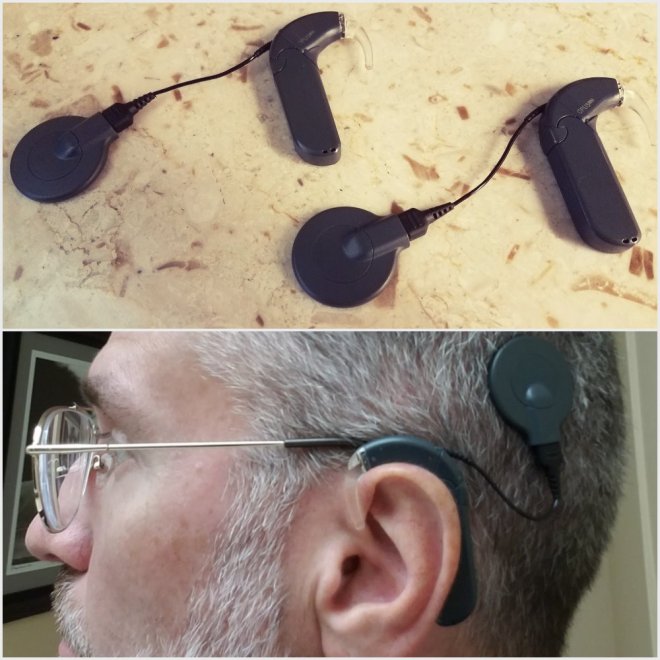
When speech comprehension became a problem, and a significant problem at that, I was referred to an ear, nose and throat specialist. I learned that speech comprehension in my right ear had fallen to the 30 percent range. Not good; not good at all. He mentioned cochlear implants to me. Huh? What’s that? Here’s the laymen explanation: Through surgery a magnet stringing 12 electrodes is inserted between your scalp and skull. Those electrodes are wrapped around the cochlea. Those electrodes are now the hair follicles that transport sound.

About three weeks after surgery you get “activated,” which means the outside apparatus, called the processor, comes on. The processor has a microphone, battery pack, coil and magnet. Outer magnet meets inner magnet, sounds come in through the outer microphone, travel up the coil to the magnet, connect with the magnet inside, and travel down through the electrodes to the cochlea, which sends the sound message to the brain.

Bam! You are hearing!

I call my cochlear implants prosthetic ears. This is how I explain them to people. “So, let’s say you have a prosthetic leg. You must learn to walk with that prosthetic leg, right? You must teach the brain to walk with that new leg. Think of the cochlear implant as a prosthetic ear.” Ding! Ding! Ding! Everybody gets it.

The acclimation period is six months, on average, for the brain to adjust to your new way of hearing and for your implant to be regularly fine-tuned for optimal hearing. I am a bilateral, which means both of my ears are implanted. My right one was implanted in 2009; my left one was implanted in 2013. Both are CIs from Med-El Corporation. Acclimation for the first one took roughly six months, acclimation for the second one took barely two months. By then my brain knew exactly what was going on.

That, my friends, was the easy part. The hard part was the fear, the shame, the concern and the uncertainty of living with cochlear implants – with prosthetic ears. You see, at the time all of this was happening I was a music critic at The Dallas Morning News. Music was a huge part of my life, not to mention crucial to my livelihood. The thought of never being able to hear music again was terrifying, permanently life altering.

Let’s go back to the hearing aids for a minute. When I covered my first concert with them on I remember looking around just to see if anybody recognized me. Or worse, if anybody who recognized me realized I wore hearing aids.

Now take that feeling and multiply it about 100 times when I was covering concerts with cochlear implants. I was downright paranoid at concerts during my initial year as a CI user. CIs are much more visible than hearing aids. They look like bionic contraptions resting on your outer ears and then magically hooked onto your scalp. Let that analogy sink in for a minute. B-i-o-n-i-c.

Nobody figured it out, or at least very few people did. But I made myself a promise in 2011: No more worrying, no more wallowing, no more fear. If you ask, I tell. If you notice, I confirm. I have nothing to be ashamed of. In fact, I’m proud of myself. I endured two surgeries and countless months of learning to hear with prosthetic ears so that I can continue to enjoy music, hear my loved ones clearly, and hold my head up high.

Today, the music critic days are behind me. I left that world, by choice, in 2013. I still love music and listen to it daily. In fact, I love music even more now because I enjoy it on my own terms. As for the cochlear implants? They are still kicking. I deal with daily limitations, of course, as this isn’t natural hearing. No, nobody sounds like helium-filled automated voices. But I still need to focus to hear, and people talking over each other is essentially background noise for me. Cell phones are fine, although they can be an issue if the connection is bad or the person on the other end is talking to me while outside or driving with lots of engine noise.

Rules of thumb: Get my attention before talking to me. Don’t try to yell something to me from another room. Don’t talk to me as you’re walking away with your back turned to me. Don’t mumble, don’t talk too fast, don’t blurt under your breath. You get the idea. Always remember that I need to focus on hearing a bit more than most people do.

Life is grand, and I carry on. I don’t resent that fateful day in 2002. The Walkman is long gone as is the cassette. But my passion for walks, for living, and for hearing still burns bright.

Love is Love: This is Real

Hearts

Love is love.

There was a time when that phrase meant just one thing to me. It’s a song by Culture Club, a beautiful ballad from the 1984 cult-following film, Electric Dreams.

But five years later, in July 1989, my life changed dramatically. I took two gargantuan leaps – I came out of the closet, and I dove into my first ever gay relationship with Steve. Today, 29 years later (gasp!), Steve and I are still together.

Love is love.

That phrase means so much more now. It means freedom to love whom you choose. It means the power to nurture that love, to let it fulfill you independently and collectively. It means there is validity in that love. Nobody can tell you otherwise.

Yet many will still try. We have so many legal and societal advancements – marriage equality, anti-discrimination laws, gay-themed TV shows on prime time, acclaimed and rewarded gay-themed movies, expansive recognition of the LGBTQ definition, increasing acceptance from the heterosexual community. But there remain many ugly roadblocks, from hate crimes to religious overzealousness, subtle (and sometimes not so subtle) discrimination to the lingering idea that somehow being gay is a switch that you flipped on and you can flip off at will.

I refuse to focus on the negative. Instead, let me tell you about my relationship with Steve. We met in Miami, where we both lived decades ago. In fact, we went to high school together, although back then we were merely acquaintances in the same graduating class. Six years after high school graduation, Steve walked back into my life. It was late spring 1989. I knew what was happening inside me. I kept convincing myself that as long as I didn’t act on any of my feelings and desires, as long as I kept it all bottled in my soul, nothing would change.

Steve changed everything. Never in my entire life have I felt such deepness for another human being.

Love is love.

About a year into our relationship, we were already living together in a local Miami apartment, we experienced the dreaded too much too soon syndrome. We went our separate ways for five months. I like to think we each grew in those five months. I think we both understood ourselves better, and we certainly understood each other with much more clarity.

Barely half-a-decade after that reunion I got a job offer in Dallas. I wanted that position. It underscored a huge leap in my career and I really felt like I needed to get out of South Florida. I was in my late 20’s and felt bold enough to explore, to write a new chapter in my life. Literally.

I swallowed hard and worked up the nerve to tell Steve. He was nicely entrenched in his career and job. I said to myself that no matter how much I loved him, and I did, I would not force him to come with me. It was not fair to uproot him because of my professional and personal dreams. So, after dinner one evening I told him that I had accepted the job offer and that I was moving to Dallas. I told him that I loved him dearly but that I couldn’t demand that he come with me. He had no job to go to, and I was asking for a major life change.

He looked me in the eyes and without missing a beat said, “When do we leave?”

Love is love.

Today, nearly 30 years later, after buying three houses and selling two, after enduring job changes, career revamping, an illness or two, and after watching the tide ebb and flow regarding gay acceptance, Steve and I are still together. Our love for each other is a mountain, a natural structure that has a few chips and pokes but has never experienced an avalanche.

You can’t tell me that what Steve and I share isn’t love. You can’t tell me it isn’t real. You can’t tell me it doesn’t mean anything. I don’t care what rules your existence, whether it be societal mores, religious beliefs, or an inherent inability to just live and let live. Steve and I share a life, a world. We keep a house, pay bills, share ups and downs, and most importantly respect each other while never taking the other for granted.

Love is love.

Believe in a Ghost

threepic

Halloween doesn’t arrive for another three months, but I already have a ghost story.

This tale requires no dark room and flashlight, and it’s about a band, not a goblin. A couple of months ago, my co-worker Oscar, with whom I talk music almost daily, introduced me to Swedish rock band Ghost. I admit that I had heard of Ghost by name and seen their gothic-campy album covers when I briefly worked at a local mom and pop CD store. Yet I hadn’t listened to them.

Oscar had me check out “Square Hammer,” a track from the band’s 2016 EP Popestar. I was hooked. Take soaring melodies, a crunchy rhythm section, heavy metal energy, pop song craftsmanship and then add an enigmatic frontman in over-the-top makeup with a penchant for Haunted House cartoonish animation. The band members all wear masks, and the lyrics are bombastic, inscrutable and macabre. What’s not to like?

I ordered the Popestar CD, as well as 2015’s Meliora album. A new Ghost fan was born.

But this isn’t about Ghost. This is about the subjectivity of musical tastes. Music, like all art forms, shines in the eyes (or ears, as it were) of the beholder. Yet music, more so than any other art form, is especially primed for scrutiny, snobbishness, and ridicule. It frequently becomes a “this way or no way” argument. It invites bullying, even.

Why? I’ve never understood that, and I spent 25 years writing and critiquing music professionally for major newspapers.

There are no rights and wrongs when it comes to musical tastes. Damn the hipsters and the know-it-alls. Ignore the fanatics and the star sycophants. Music is all shades of gray. What brings people to the musical table is different each time. Even when you have two disparate people who happen to like the same band or singer, the reasons and backgrounds are usually completely different.

An example: I’ve never been a huge rap music fan. What little rap I do like ended in, say, 1993. Oscar, my Ghost-wielding co-worker, is a big fan of today’s rap – from Kendrick Lamar to Joey Bada$$. While I can see why Oscar likes them, even appreciate their way with the mic, I have no interest. It’s not my taste. I’m a singers guy. I come from the old school of ‘70s disco, ‘80s synth-pop and artists that took me to another realm with their voices, their melodies, and their rhythmic passion.

That’s another thing: Music is generational. I grew up in the ‘70s and ‘80s, so that music is near and dear to my heart. It shaped my tastes. I could sit here and tell you that today’s music sucks in my best “Get off my lawn!” old man hollering. I could try to convince you that teens and 20-somethings are worshipping tunes pieced together by tech-savvy studio wizards who gainfully pack everything plus the kitchen sink into a compressed audio file they think will keep multi-taskers paying attention.

Do I believe this? Yes. Does it mean anything? No. My opinion of today’s music, or any era’s music, is strictly my own. It is formulated from my vantage point, from my sensibilities, from my shade of gray. This doesn’t make your shade of gray any less valid. Never ever let anybody pressure you into admitting you like a band or a style of music as your “guilty pleasure.” If that music gives you pleasure, you shouldn’t feel guilty about it. Period.

I’m always fascinated by musical tastes. For me it speaks volumes about the person doing the liking. And I always want to know why. Why is Oscar a fan of Kendrick Lamar? Why am I drawn to Ghost, especially when those that know me well might be surprised that I could dig the sound of a campy, faux-devil-worshipping, wink-wink melodic metal band?

That, my friends, is the real fun dialogue. Our musical tastes say a lot about us. They are windows for getting to know the person, not tools for mockery.

Now if you’ll excuse me, I’m going to go conjure up a Ghost.


I Was an Immigrant: My Journey to the United States

Mario

It was January 1967. I was 1.5 years old. I remember nothing.

But I have it from very reliable sources – my parents – that I was carried into a plane with my older brother, my older sister, my mom and my dad. We were on one of the final freedom flights off the island of Cuba. Why did we wait so long? My dad was tirelessly trying to convince his sisters to flee Castro’s communist regime. They wouldn’t budge.

Clearly, though, we had to leave. By the time I was born (mom says I was a surprise), my parents were in financial straits. Dad’s refusal to join Castro’s militia spelled the end of his lucrative career as an accountant and bookkeeper. My mom baked and sold cakes to help us survive. I didn’t have a crib or a bassinet. I had a dresser drawer and hand-me-down blankets.

I don’t remember anything about Cuba. Well, that’s not entirely true. There are images in my head: My father sitting on the back porch of our middle-class home overlooking the ocean. He’s on a rocking chair, legs crossed, and I’m perched in the nook of his thighs. There we would sit for hours soaking up the cool ocean breeze. Dad told me this story so many times that I feel like I lived it, like I remember it clearly.

That fateful plane landed in Miami, Florida. We took that infamous 90 miles trip. We were immigrants searching desperately for a better life. I’ve heard the stories of my dad working two jobs, one as an all-night security guard, while my mom had her hands quite full with a toddler and two adolescent kids. I was told about a dilapidated apartment, factory work, government cheese and milk handouts, the seemingly unending struggle to make enough money to reach the next destination in the long journey.

We were immigrants and we had to prove our worth. We were in a new city, a new state, a new country. My dad, a proud and very generous man, refused to just give up. I know that even my mom did some factory work for a little bit because every dollar counted.

It is during times like these, when immigration is at a heightened state that I think about my early years. What would my life be if dad hadn’t urged us to board that plane? Where would I be now? Not a day goes by that I’m not grateful for my father’s sound decision, for the values that my parents instilled in me, particularly the one about hard work and dedication getting you far up the ladder. I am thankful for the opportunities this country afforded me.

I became a United States citizen when I was 12. So did my father, and so did my brother. I remember succinctly dressing up in a suit and tie and heading to the courthouse. I still have my certificate with a black and white, passport-style photo of a chubby kid smiling. I signed that certificate in my best penmanship. I knew this was important.

Throughout my life, I always called myself a Cuban-American. I embrace both cultures proudly. I speak, read and write English as if it were my native tongue. I speak, read and write Spanish with a sense of history and satisfaction. I am bilingual, the product of two rich cultures, and I wouldn’t change a single thing.

My entire existence, just about, has been spent in this country. I went to school; I bust my butt for good grades. I earned an Associate in Arts degree and a Bachelor of Arts degree. I worked from the time I was in 9th grade, a part-time gig at a mom-and-pop pharmacy. I worked all through college, paying taxes to Uncle Sam every step of the way. I vote. I have a passport. I live the American Dream full steam ahead.

About 52 years after a blond, unaware and innocent baby heard pilot engines roar, he feels deeply for every single immigrant that crosses a border by car, by plane, or by foot. The decision to make that grueling journey, to sacrifice all that you know in hopes that what you don’t know will be a marked improvement, is life-altering.

Is seeking exile pretty? Is it neat and clean with T’s crossed and I’s dotted? Not at all, not even close. Remember the Statue of Liberty did say to give her the tired, the poor, and the huddled masses yearning to breathe free. Masses are messy. The finer details, presumably, are to be sorted out later.

But the desire is fierce, the risk-everything need to escape pain and suffering and embrace soothing prosperity consumes you. This is exactly why families drag wide-eyed boys and girls, and unsuspecting babies, to a brave new world.

I made that journey in 1967. I was 1.5 years old. I remember nothing. But today, I feel everything.