I remember the day well. Warm, sunny, perfect weather for a walk. Taking walks is part of my daily life. I love it. It centers me, provides great exercise, and clears my mind. Anyway, it was 2002. I grabbed my Sony Walkman (yes, I still had one then!), popped in Cheryl Lynn’s In the Night cassette, and off I went.
Barely five minutes later I noticed a problem. I couldn’t hear the music in my right ear. Hmm, that’s interesting. Surely my headphones are malfunctioning, or the Walkman needs fresh batteries. I flipped the headphones around. Nothing. My heart began to sink. In the dark, foreboding recesses of my mind I knew it was me.
The hearing loss journey had begun. I tried to keep it to myself, tried in vain to work around it, but it wasn’t long before I was seeing an audiologist. She initially thought there was the possibility that I had an acoustic neuroma – basically, cancer in my ear. That was a devastating maybe. But the MRI proved negative, and there commenced the conversation about hearing aids.
I wore hearing aids for about seven years. Damn, I hated them. They felt cumbersome, made my ears itch and sweat, beeped annoyingly when they needed new batteries. Plus, all they really did was make everything louder. Not clearer, not sharper, just louder. Ugh!
When speech comprehension became a problem, and a significant problem at that, I was referred to an ear, nose and throat specialist. I learned that speech comprehension in my right ear had fallen to the 30 percent range. Not good; not good at all. He mentioned cochlear implants to me. Huh? What’s that? Here’s the laymen explanation: Through surgery a magnet stringing 12 electrodes is inserted between your scalp and skull. Those electrodes are wrapped around the cochlea. Those electrodes are now the hair follicles that transport sound.
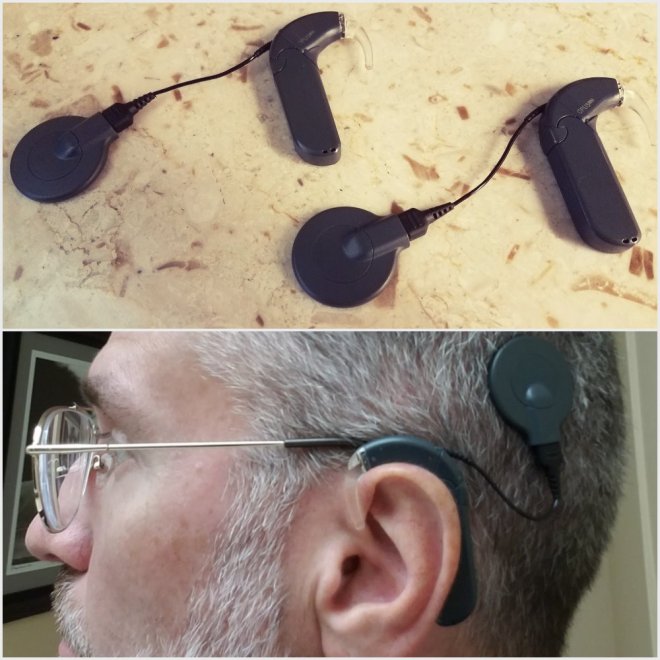
About three weeks after surgery you get “activated,” which means the outside apparatus, called the processor, comes on. The processor has a microphone, battery pack, coil and magnet. Outer magnet meets inner magnet, sounds come in through the outer microphone, travel up the coil to the magnet, connect with the magnet inside, and travel down through the electrodes to the cochlea, which sends the sound message to the brain.
Bam! You are hearing!
I call my cochlear implants prosthetic ears. This is how I explain them to people. “So, let’s say you have a prosthetic leg. You must learn to walk with that prosthetic leg, right? You must teach the brain to walk with that new leg. Think of the cochlear implant as a prosthetic ear.” Ding! Ding! Ding! Everybody gets it.
The acclimation period is six months, on average, for the brain to adjust to your new way of hearing and for your implant to be regularly fine-tuned for optimal hearing. I am a bilateral, which means both of my ears are implanted. My right one was implanted in 2009; my left one was implanted in 2013. Both are CIs from Med-El Corporation. Acclimation for the first one took roughly six months, acclimation for the second one took barely two months. By then my brain knew exactly what was going on.
That, my friends, was the easy part. The hard part was the fear, the shame, the concern and the uncertainty of living with cochlear implants – with prosthetic ears. You see, at the time all of this was happening I was a music critic at The Dallas Morning News. Music was a huge part of my life, not to mention crucial to my livelihood. The thought of never being able to hear music again was terrifying, permanently life altering.
Let’s go back to the hearing aids for a minute. When I covered my first concert with them on I remember looking around just to see if anybody recognized me. Or worse, if anybody who recognized me realized I wore hearing aids.
Now take that feeling and multiply it about 100 times when I was covering concerts with cochlear implants. I was downright paranoid at concerts during my initial year as a CI user. CIs are much more visible than hearing aids. They look like bionic contraptions resting on your outer ears and then magically hooked onto your scalp. Let that analogy sink in for a minute. B-i-o-n-i-c.
Nobody figured it out, or at least very few people did. But I made myself a promise in 2011: No more worrying, no more wallowing, no more fear. If you ask, I tell. If you notice, I confirm. I have nothing to be ashamed of. In fact, I’m proud of myself. I endured two surgeries and countless months of learning to hear with prosthetic ears so that I can continue to enjoy music, hear my loved ones clearly, and hold my head up high.
Today, the music critic days are behind me. I left that world, by choice, in 2013. I still love music and listen to it daily. In fact, I love music even more now because I enjoy it on my own terms. As for the cochlear implants? They are still kicking. I deal with daily limitations, of course, as this isn’t natural hearing. No, nobody sounds like helium-filled automated voices. But I still need to focus to hear, and people talking over each other is essentially background noise for me. Cell phones are fine, although they can be an issue if the connection is bad or the person on the other end is talking to me while outside or driving with lots of engine noise.
Rules of thumb: Get my attention before talking to me. Don’t try to yell something to me from another room. Don’t talk to me as you’re walking away with your back turned to me. Don’t mumble, don’t talk too fast, don’t blurt under your breath. You get the idea. Always remember that I need to focus on hearing a bit more than most people do.
Life is grand, and I carry on. I don’t resent that fateful day in 2002. The Walkman is long gone as is the cassette. But my passion for walks, for living, and for hearing still burns bright.
 Mario's Musings
Thanks for your story. I am just beginning hearing with a bionic ear now – I was activated 3 weeks ago. A lot of learning to do it seems but I am looking forward to it.
LikeLiked by 1 person
I’m so happy for you, Ron. Please be patient, and know you will get frustrated at times. But when clarity of sound really starts to happen, you will be amazed. Good luck. Don’t hesitate to reach me here or on Facebook if you have any questions along the way. All the best.
LikeLike
My dearest Mario, I thank you for sharing this story. At one point in my life, my hearing was affected. I just got off of an airplane, and my ears did not readjust. It was a scary week. My constant thought was that the musical soundtrack in my head would not add new tunes. That week, I thought about Beethoven and his rage when he lost his hearing.
As one of your lifelong friends, I admire you so much more now. Some struggles in life must remain silent as we live them. Once we conquer them and our self-confidence returns, humanity dictates that we share the experience to empower others. Love and blessings to you always.
LikeLiked by 1 person
Thank you, my dear Elvie. Loved your words. Yes, in life we all need to settle into our journeys and our stories. They all see the light of day in due time. Love and hugs to you.
LikeLike